paintings
Click on the thumbnails below
to view the gallery

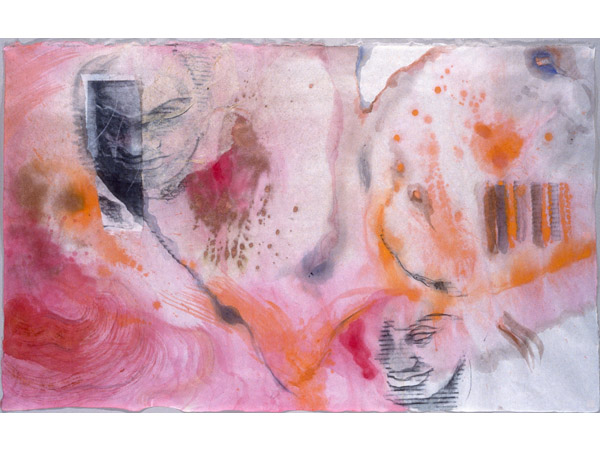
MAP OF THE SLEEPING STONES:
I was guided through the many temples of Angkor on the first week of the New Year 2001. I took photographs and also sketched.

The thousands of dancing apsaras, gods, goddesses, and mythic beings that grace the architecture seem to have been carved from a proscribed set of formulas. The carvings seem to embellish every possible surface, so that the temple complexes appear as giant drip-castles in the distance.

However the vicissitudes of time, the elements and human use as well as destruction, have changed these formulaic portraits into sculptures with hauntingly individual characteristics.

I took photos of faces on the Leper King Terrace, in the Royal Square of Angkor Thom. Those that were not sheltered from the elements compelled me in a way that the carvings that were better preserved did not. It was like seeing beneath the superficial beauty to some more elemental truth, about the human face, and its utter recognizability even if erased and ablated by water, wind and touch. A hollow, a curve, a slight edge of stone, and a forehead, nostril, and trace of a smile gradually come into focus.

I transferred some of these photographs onto handmade paper and used them as elements of collage in the paintings — a brushed surface that evoked water or movement or the sedimentation process that causes sandstone to form. I love the unabashed beauty of pink, a blossom-beautiful shade that I chose for this series to express the evanescent nature of life.

— journal notes, Cambodia 2001

Sleeping Stones 1
Sleeping Stones 2
Sleeping Stones 3
Sleeping Stones 4
Sleeping Stones 5
Sleeping Stones 6
Sleeping Stones 7

Click on the above image
to see Mary's sandstone portraits photographed at
Angkor Thom,Cambodia

back to Antiquities
Southeast Asia page
Dreamers Series