paintings

Notes toward the Indigo Sketches:

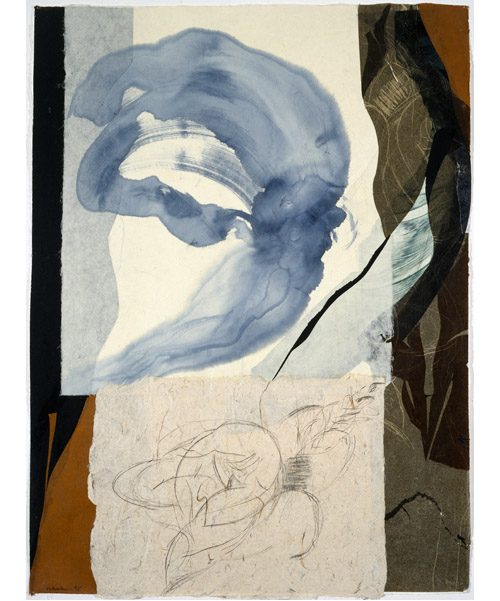
Drench a brush in a pool of indigo watercolor laced with silver pigment and let it puddle onto thin, porous sheets of Japanese kitakata paper spread out on the floor. Each stain widens concentrically long after I lift the brush. Another stroke blends with, and overlaps the first as the paint seeks its remotest boundaries, like the submerged shelf that is a continentÍs true edge. The color saturates the paper so much in some places that it will tear if I disturb it. In other areas, the color stretches itself so thin that it is as wispy as cartilage in an x-ray of bone.

Leaf through a notebook containing some little sketches of antiquities in the Louvre made earlier this summer: full-hipped, curvaceous statuettes from Suse, Mesopotamia, Meskéné, d'Obeid. Most of them could fit in the palm of my hand. Drawings are tokens that jar the memory.

Pull a stack of paper made with gampi and mitsumata fibers from the flat files. Remember the "dragon-clouds" of pulp afloat in a vat of cool water: how they spiral like weather patterns when my hands stir counter-clockwise to distribute the fibers before dipping the screen. Hear the smack of a vacuum as the horizontal screen breaks through the surface tension of the water. This paper is thick; dipped three times, it gathers a new layer of pulp as water drizzles through the screen with each pass.

Cover a sheet of handmade paper with waxy smoke-colored tissue paper coated with graphite so that what I draw is invisible to my eye. Rely on memory. Divine shapes from the indigo watercolor that has sunk into the paper, as only a stain can. Use several crude pointed objects - a nailhead, a hairpin, a ceramic shard - to draw, blindly. Displaced graphite marks the paper beneath it, leaving a mirror-image blind sketch on the opposite side of the tissue.

Collage together this handful of parts to make a whole. Leathery brown kakeshibu paper, impregnated with the juice of persimmon bark, is used traditionally in Japan as kimono stenciling paper because it is tough and slightly waterproof. Use it here - along with the thin tissue - to create levels of transparency. Let the larger form envelop the smaller sketches.

So many millennia ago human hands fashioned those sturdy polished figures I saw in the Louvre with such delicacy and intelligence. With reverence for the essence of human life, they carve tokens in pieces of amber, bone, and stone. In reverie, I made these sketches a patchwork of papers, stained, cut and feathered and there is between us the gentle solace of continuum.

Antiquities

Old Marks, New Marks

Click on any image and follow the arrows to
the image gallery.