|
Mani
Wall
I visited Mustang, Nepal, led by my daughter, Sienna. One day on horseback,
we encountered a sinuous thousand foot long wall of boulders etched with
Tibetan prayers, mani. Its form rose from the plain, foreshortening space
like an oncoming train. The wall represents intestines of a demoness who
had been dismembered and reconfigured as part of the sacred landscape,
when the incipient catechism of Buddhism absorbed and reinterpreted local
worldviews. The wall was washed in sacred mineral colors of the three
protector deities: rust red for Vajrapani, clay gray for Manjushree, and
chalk white for Avalokiteshvara.
This mani wall that I encountered in Mustang, Nepal, etched itself into
my memory. The inscribed mani looked like fossils. The painted stripes
like the minerals that naturally weep out of oxide rich sedimentary rock
of the trans-Himalayan plateau.
The act of drawing helps me to see, and it allows what I see to become
a part of me.
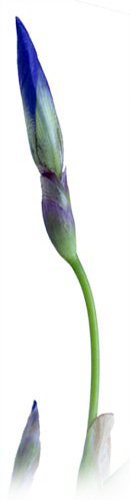
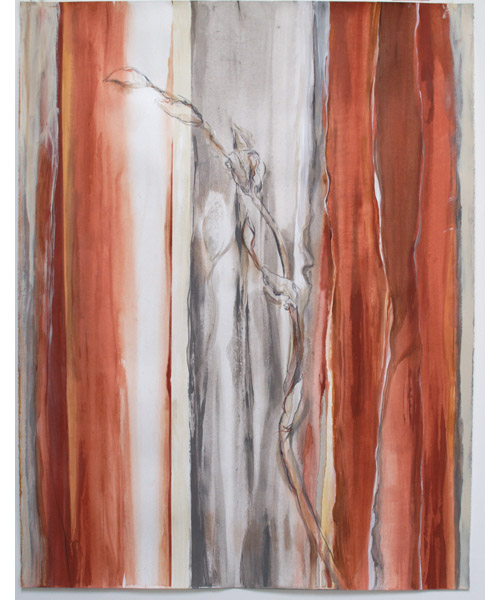
This series of paintings began with graphite drawings of an iris flower
in all its phases. A flower is a beautiful thing. A flower’s life
span is relatively short so it is easier to appreciate one complete living
cycle, from tender bud to brittle detritus, to pod. I poured and brushed
layers of color—sienna, grey and white—over the drawings so
that the colors enveloped them. The images of flowers are my prayer, embedded
in painted paper, still as a fossil, bone still, and drenched with the
colors of the earth.
Mani is from *Om mani padme hum – literally, "Hail
the jewel in the lotus" - a mantra to Chenrezig/Avalokiteshvara,
the Bodhisattva of compassion, of whom His Holiness the Dalai Lama is
an incarnation.

see the artist's book
A Sacred
Geography: Sonnets of the Himalaya and Tibet
see images from the show at UCLA's Fowler Gallery
Mani Wall and A Scared Geography

|
|
| |
UCLA
Fowler Museum exhibition: “Mani Wall and A Sacred Geography:
an installation of paintings, the artist book by Mary Heebner and Sienna
Craig with photography by Macduff Everton."
Opens June 11, 2006 . This exhibition will
be concurrent with “The Missing Peace: Portraits of the Dalai Lama,”
a travelling exhibition of 50 artists initiating at the Fowler Museum.
|
|